
Columbia Games / 30 September 2026
Deity integration: building a provider-independent entitlement framework
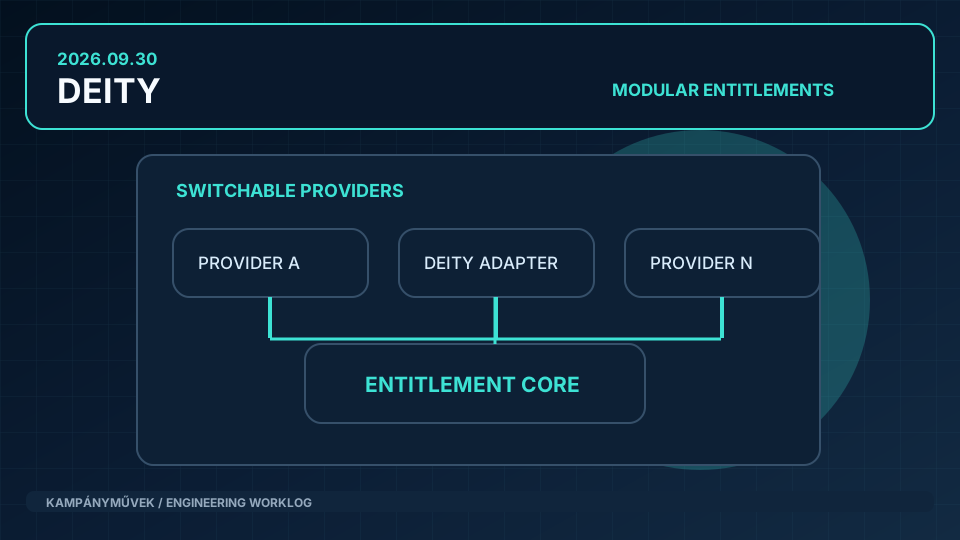
We separated external digital entitlements into provider adapters and queue-driven state transitions so Deity can later be disabled or replaced without rewriting commerce logic.
Situation
A direct integration between a partner API and order processing can be quick to implement, but it also ties commerce behavior to the partner's contract, outages and API lifecycle. For Columbia Games, a core requirement was that Deity could be switched off and another provider introduced without replacing the surrounding checkout system.
Approach
We structured the implementation around a provider registry, modular adapters, explicit entitlement states and isolated queue operations. QUERY and CANCEL flows, retries, reconciliation and provider failure handling were separated into testable components. Local smoke and end-to-end scenarios exercised these paths while outstanding parts of the provider contract were clarified with Brian.
Outcome
We established a working provider-independent foundation for external entitlements, including a repeatable test route. We did not classify Deity as live: remaining contractual details and production activation were deliberately retained as separate control points.